So, here's what I've been pondering the last month or so:
It’s well known that culture shock has stages. Upon arriving in Uganda I was stuck by how different everything was – a developing country in the tropics looks a lot different than DC or Colorado. There’s the small girl who at home would be playing with her dolls but here is carrying around her baby sister. Or the gaggle of kids that are out to collect firewood. How many kids do you know who are willing to spend the day collecting firewood to make supper and grasses to make brooms to sell? How bout a group of 10 kids running away from a kitten in terror? Or a two year old kneeling to greet you. Not to mention the everyday differences: local markets instead of grocery stores, basins and good ‘ol elbow grease instead of washing machines, skirts instead of trousers.
Even when I’m shopping the man who will try to sell me an old sheet for $5 will sell me a handmade basket for 75 cents and think he’s ripped me off. I miss every other social clue (sometimes I’m sure everyone here thinks I’m a bumbling idiot), and often find my self asking “what did you say?”, “what do you mean by that”. It’s one thing to say we all speak English, but another to realize how many colloquialisms are in a language. Here if someone offers you something, and you say “that’s okay, don’t worry about it” they’ll hand it right over. “How’s home?” has come to mean “how’s your family?”. And a ‘yes’ can be indicated by the raise of an eyebrow.
Yet, after spending time with Ugandans I came to the firm conclusion that people are the same everywhere. We all laugh and cry; people gossip; some are talkative, some are quite; parents worry about their kids; kids shrug off their parents; students think teachers want them to fail; teachers feel bad when their students fail.
Now, however, I’m realizing that we’re not all the same. Many things are similar, but there are core beliefs that everyone holds, and while they vary person to person, they vary a lot between cultures. Sometimes it’s little things, like realizing the word for ‘wife’ in Lusoga is ‘cook’. Or that it’s assumed that, as a Muzungu, I must 1) have lots of money and 2) want to give it to everyone who asks. This is a misconception brought about by the fact that most Muzungus who come here bring a lot of money, and are more than happy to give it away (not that I blame them, there really are a lot of people here who need the money, I just hate the stereotype).
Other things are a bit harder. Like sending children, “go to town and get me tomatoes” or “you, student, go pick me a chair”. It really bothered me at first because that’s not how we treat children, or students, at home. And, yet, aren’t a lot of our kids spoiled? We treat our children as equals, and yet they aren’t. We still expect them to listen to us, do as we say, and not argue, too much.
In some ways I think it ties back to language. At home every child knows that the proper way to ask for something is “may I please have____”. In Lusoga it’s simply “mpaku ____” where ‘mpa’ means ‘give me’ and ‘ku’ makes it polite. Here the please is implied. And when you think about it, how much choice does a child have if their parent says “will please carry this?” We may insert the words ‘will you’ and ‘please’ but they’re basically just formalities. Yet, having grown up in America, it’s really hard for me to get used to not hearing ‘please.’ It’s so small, but it can really bother me. Just give me time though. By the time I come back I won’t be saying please and will annoy everyone.
But, outside of language, more is expected from children here. We don’t expect our children to cook, clean, and iron, while we relax from a hard day and catch up on the news. Yet, doesn’t that encourage independence? How many students at home make it all the way to university before learning how to cook or clean? And we have it easy. Cooking does not involve lighting a fire or a charcoal stove; washing clothes just requires pushing a few buttons; water comes out of the tap fresh and ready to drink. Our children can read textbooks, pass exams, navigate a computer and the internet, but can they live on their own?
Children here can wash clothes, fetch water, take care of the baby (ever seen a 6-year-old looking after her baby brother?), and yet they can’t read a textbook (which is written in their 2nd, 3rd, or 4th language) and so call themselves ‘backwards’ and ‘poorly educated’.
Who’s to say they’re not forwards and we’re backwards?
That’s a bit of what I’ve been pondering, as well as how to help students to not fail their exams. Anyone with suggestions about how to teach 50+ students who have no time to study, no textbooks, and who understand only about 75% of what I say….I’m wide open to suggestions. We’re covering insects (butterflies, house flies, mosquitoes, and bees) and hopefully some ecology next term. I’m also picking up one stream of mathematics, also S.2, which should be a lot of fun. I think I’m finding that while I prefer studying biology, I prefer teaching mathematics. At least there I’m on solid ground and there’s less memorization involved.
P
Monday, August 24, 2009

Sunday, June 28, 2009
Kitten! and other exciting things
So, it’s been a while. I’ve had limited internet access, but I’ve also been at a loss for what to write.
So, the basics. I have a kitten! She’s almost 3 months (born April 4th), and her name is Tara. She is extremely friendly, though has decided that my mosquito net is perfect for ‘chasing’ especially at night, and that books are great for scratching, or sleeping on. Which is adorable, except when I’m trying to use them for lesson plans. I’m so glad to have her though; I never realized how lonely it is to be by yourself so much. My neighbors think I’m a little crazy, though the youngest, Jerry, just adores her. He loves animals of all kinds, and she’s a small tiger to him. He’s still a little nervous around her, but they’re both getting used to each other.
The other news is that the school has a guitar. I just got a tuner in Kampala, and some sheet music and a book with some chords. I’ve managed G, C, D, A, and E so far. It takes me about a min to go from one chord to the next, but with those five chords I can play Wagon Wheel, which my neighbors will soon be very sick of. It’s a really calming to be able to play when I have downtime, and is a little bit of home.
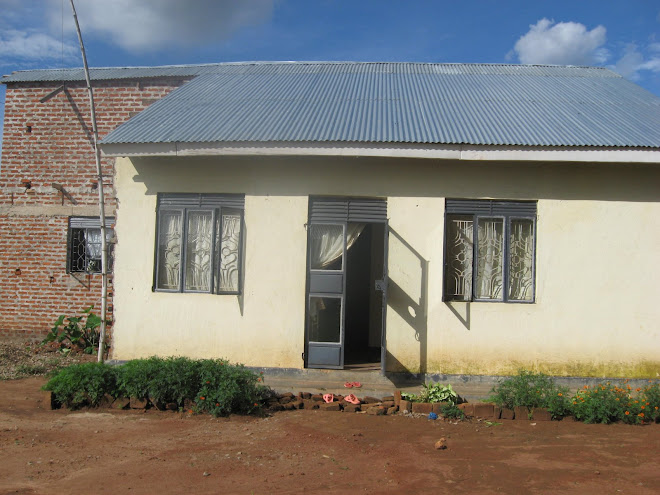
My house is currently ‘under construction’. They’re putting a sizeable addition onto the back portion (a sitting room, bathroom, and two bed rooms) as well as an outdoor kitchen and a latrine (which I love, by the way. I’m sick of how much water the flush toilet wastes). I’ve never seen a building go in so fast, the whole thing from start to finish is going to take less than a month, and that includes digging the pit latrine, by hand. The rush is due to the fast-approaching arrival of 15-20 secondary students and their chaperones from our link school in England. They’ll be in country for a couple of weeks and will spend a week or so at the school; going to classes, doing some projects, eating Ugandan food, and getting to see the area. It’s the talk of the school. That and the athletic competitions, Minister of Education’s visit, netball tournament, mock exams, and the head teacher’s trip to the U.K. It’s been pretty busy, to say the least.
Athletics: each term has a different ‘sport’. 1st term was ball sports (netball, football, and volleyball), 2nd term is athletics (track and field) and 3rd term is music and drama (because the candidate classes – S.4 and S.6 – sit exams in November, and I guess music and drama take less time from studying…something like that). For each sport there are interhouse competitions (we have 6 houses, kinda like Harry Potter houses). Houses send their best students to each race; the winners go to district competitions and from there to national competitions. For sports like football, I think they pick the best players to represent the school, though I’m not sure as that was back in Feb/Mar before I got here. Anyways, this meant a field-day-esq event with 100m, 200m, 400m, 5km, 10km, 4X100m relay, 4X400m relay, javelin, long jump, high jump, discus, and some other events I don’t remember. It was a lot of fun, but scary to see the students after the long races. They couldn’t stand on their own, and had to be carried to the table to report their placement. The students barely train for the events, most don’t eat lunch, and they’re running in the hot sun. These are tough kids.
Minister of Education: there are two new blocks that just got built for the S.1 students in our school. With USE (see earlier posts), the number of students is increasing rapidly, and so the school got government money to build new blocks. Friday (6/26) the Minister came and was part of a big opening ceremony for the new buildings. Unfortunately, I was unable to attend due to an All Volunteer Conference (which was awesome, so while I was really bummed to miss out, it was worth it). So, I have no clue how the whole thing went. I was sorry to not see the minister. She’s been in office forever (since Obote, if not Amin, which is 20+ years) and is supposed to be really good.
Netball tournament: just like the football tournament, though closer (Mbale, opposed to Fort Portal). So, netball: the best way I have found to describe it is ultimate Frisbee with a basket ball, on a basketball court, except the hoops don’t have back boards. At least, that’s what I understand so far. I still haven’t gotten to play, and don’t know all the rules. A lot of the football girls also play netball, so they haven’t been playing football at all. I talked to one of the girls, and I’m hoping to start up with them this week, now that netball will be over. Maybe 2-3 days a week for a couple hours? We’ll see how it goes.
Mock exams: They’re for S.4 and S.6 to start preparing them for the exams in November. Kinda like we take PSATs, except that they’re written by teachers. So, a lot of the teachers are busy writing the exams, and all the candidate classes (I’m not sure whether S.5 students take mocks, hmmm…) are busy studying. My neighbors – Barbara, Jennifer, Oscar, and Dennis work so hard. They’re up at 5 studying, mop at 6, go to school around 7, come home 5/6ish, clean, cook, and go for night preps (studying) around 7/7:30, and then got to sleep around 10/11. And the candidate classes study on the weekends, so they have almost no free time. They make me feel lazy.
All Volunteer Conference: 3 full days of sessions on everything from HIV/AIDs to TAP (technology against poverty) to alternative discipline to grad school and everything in between. Many of the sessions were run by PCVs, which meant they were very applicable to what we’re doing. And just talking to the PCVs who’ve been here a while about their experiences and how they’ve dealt with various situations was very helpful. We also got to stay at this posh hotel with a swimming pool. And hanging out with other PCVs is always a good time. The people here are wonderful.
Anyways, this post has gotten really long, and I’ve been sitting as this computer for way too much time. Hellos to everyone! Please do send me letters/emails/whatever, I feel out of touch with what everyone’s up to.
Sunday, June 14, 2009
Becky Starts Teaching
It will be a couple more weeks before Becky gets reasonable internet access so I thought I’d update the blog with some general facts.
Becky has now been teaching for two weeks. She has a couple of classes of introductory biology (9th grade), ecology (12th grade), and genetics (13th grade – it’s a school based on the British system). The Ugandan school system has required some adjustments, but she seems to be enjoying the teaching. Teaching and class planning and preparation have kept her very busy.
Becky’s also settling into her house. She’s been shopping for things such as shelves and glass jars with lids to store food. Cooking is mostly on a propane stove, but she found a charcoal burner which she uses for baking bread (in a Dutch oven) and other things that take a long time. This week’s culinary accomplishment was making peanut butter with a friend – starting with “g-nuts” which were dried, roasted, and smashed with a mortar and pestle. A mortar and pestle are now on her shopping list.
Barbara
Subscribe to:
Posts (Atom)